Bending Reality: Time and Space Warp - Unveiling the Secrets of Einstein's Theory of Relativity
Bending Reality: Time and Space Warp - Unveiling the Secrets of Einstein's Theory of Relativity
Introduction
Time and space, the fundamental fabric of our universe, have always intrigued humanity with their mysterious nature. In the early 20th century, the genius of Albert Einstein revolutionized our understanding of time and space through his theory of relativity. Within this groundbreaking theory lies the mind-bending concepts of time dilation and space warp, challenging our intuitions and transforming our perception of reality. In this blog, we embark on a journey to explore the fascinating world of time and space warp, where the rules of the universe seem to bend and stretch, revealing the interconnectedness of space, time, and gravity.
Einstein's Theory of Relativity
Albert Einstein's theory of relativity, published in 1905 (special relativity) and 1915 (general relativity), is one of the most profound and validated scientific theories in history. It describes the relationship between time, space, and gravity, reshaping the way we understand the fabric of the cosmos.
Time Dilation
One of the most perplexing consequences of special relativity is time dilation. According to this concept, time is relative and depends on the relative motion between observers. Imagine two individuals, one traveling at near the speed of light and the other at rest. The person traveling at high speed experiences time passing more slowly relative to the stationary observer. This phenomenon is not noticeable in everyday life but becomes significant when velocities approach the speed of light.
Space Warp and Gravity
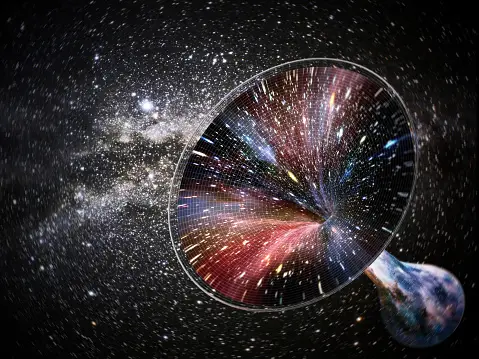
Einstein's general relativity introduced a groundbreaking perspective on gravity by presenting it as the warping of spacetime. Massive objects, such as planets, stars, and black holes, curve the fabric of spacetime around them. When a smaller object, like a planet or a satellite, moves near a massive body, it follows the curvature of spacetime created by the massive object. This bending of spacetime causes the smaller object to experience what we perceive as the force of gravity.
Gravitational Time Dilation
As a consequence of space warp, there is another fascinating aspect known as gravitational time dilation. In regions of strong gravity, time moves more slowly compared to regions of weaker gravity. This has been experimentally confirmed, and it has even been observed that clocks near massive objects, such as black holes, tick at a different rate than clocks far away.
The Twin Paradox
One of the intriguing thought experiments arising from time dilation is the Twin Paradox. In this scenario, one twin embarks on a journey through space at high speed, while the other remains on Earth. When the traveling twin returns, they would have aged less compared to the twin who stayed on Earth, showcasing the effect of time dilation due to relativistic speeds.
Astrophysical Implications
Einstein's theory of relativity has far-reaching implications in astrophysics. It explains phenomena like gravitational lensing, where light from distant objects is bent by the gravitational pull of massive objects, making it possible to observe distant celestial objects that would otherwise be hidden from view.
Conclusion
The concepts of time and space warp, as elucidated by Einstein's theory of relativity, unveil the enthralling interplay between the fabric of the universe and the force of gravity. These mind-bending ideas challenge our everyday intuitions and lead us to a deeper understanding of the cosmos. As we contemplate the complexities of time dilation and space warp, we marvel at the interconnectedness of space, time, and gravity, discovering that our universe is a marvel of mystery and wonder. Embrace the profound insights of Einstein's theory of relativity, and let it ignite your curiosity to delve further into the fascinating realm of time and space - a realm where reality bends and stretches, revealing the remarkable intricacies of our universe.


Comments
Post a Comment