Exploring the Vastness: The Incredible Scale of the Universe
Exploring the Vastness: The Incredible Scale of the Universe
Introduction
The universe, a mesmerizing expanse of galaxies, stars, and planets, has captivated human curiosity for millennia. From the infinitesimal particles that make up matter to the mind-boggling distances between celestial bodies, the scale of the universe is a testament to the awe-inspiring wonders of nature. In this blog, we embark on a journey to explore the incredible scale of the universe, delving into the mind-blowing dimensions that both humble and astonish us. Let us venture beyond our earthly boundaries and peer into the depths of the cosmos, where the smallest particle and the largest galaxy coexist in harmony.
The Microcosm: The World of Particles
At the smallest scale lies the subatomic world, where particles like electrons, protons, and neutrons form the building blocks of atoms. These atoms combine to create molecules and give rise to the intricate tapestry of matter that shapes our reality. Within the nucleus of an atom, the distance between protons and neutrons is incredibly tiny, measured in femtometers, equivalent to one quadrillionth of a meter. To put this into perspective, if an atom were scaled up to the size of a football field, the nucleus would be about the size of a grain of rice at the center.
Our Cosmic Neighborhood: The Solar System
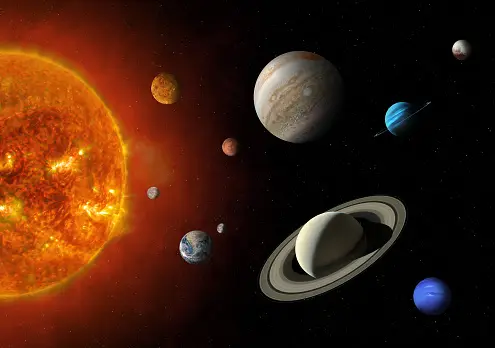
Moving outwards, our solar system comes into view, dominated by the radiant Sun at its center. The planets, moons, and asteroids revolve around the Sun, each following its unique orbit in an elegant celestial dance. The distance from Earth to the Sun, known as an astronomical unit (AU), is approximately 93 million miles. A journey to the edge of our solar system would require traveling over 4 billion miles!
Galaxies: Islands of Stars in the Vastness
Zooming further, we encounter the mind-boggling scale of galaxies. Our Milky Way galaxy, home to billions of stars, stretches across approximately 100,000 light-years. One light-year, the distance light travels in a year, is about 5.88 trillion miles. Imagine traveling at the speed of light for 100,000 years just to traverse the length of our galaxy!
The Universe on a Cosmic Canvas
As we extend our gaze even beyond the Milky Way, we encounter a sea of galaxies scattered across the cosmic canvas. The observable universe, estimated to be about 93 billion light-years in diameter, contains an unimaginable number of galaxies, each with countless stars and potential planets.
The Speed of Light and Cosmic Limitations
The speed of light, a cosmic constant at approximately 186,282 miles per second, defines the ultimate speed limit of the universe. Even though light travels at incredible speed, it takes millions or even billions of years for light from distant galaxies to reach us. When we observe distant celestial objects, we are essentially witnessing their past, as the light we see left them millions of years ago.
The Humbling Beauty of the Universe
The incredible scale of the universe humbles us and reminds us of the vastness of existence. From the microcosm of subatomic particles to the cosmic dance of galaxies, the universe's dimensions challenge our understanding and ignite our curiosity. As we explore and contemplate the mysteries of the cosmos, we gain a profound appreciation for our place in the grand tapestry of the universe.
Conclusion
The incredible scale of the universe invites us on a journey of wonder and awe. From the subatomic realm to the distant reaches of galaxies, the cosmos unfolds before us, revealing its majesty and complexity. As we contemplate the vastness and mysteries of the universe, we are humbled by the realization of our place in the cosmos. The incredible scale of the universe beckons us to continue exploring, learning, and reaching for the stars, as we seek to uncover the secrets that lie beyond our earthly horizons. Embrace the magnificence of the universe, for in the grandness of its scale, we find inspiration and an enduring sense of wonder that connects us to the very essence of existence.


Comments
Post a Comment